Iris Control Room
All bridges on your network monitored through a single dashboard
Iris, our centralised dashboard, provides a complete and up-to-date view of all the information you need to make fast, effective decisions. Sensors, data analysis, and monitoring are integrated into a turnkey service, ideal for clear, safe, and efficient infrastructure management.
The benefits of Displaid dashboard

User-friendly experience
A simple, intuitive interface developed through strategic collaboration with key stakeholders.

Ready-to-use information
Immediate operational guidance and alerts to support proper asset management.

Customised reports
Automatic generation of periodic reports tailored to the specific needs of each client.
Real-time control
of the entire network
The platform provides an immediate overview of the entire network, featuring an intuitive interface that combines geographic location, summary values, and colour codes to interpret bridge health at a glance. This clear and detailed vision allows for targeted planning of in-depth inspections and interventions.
Assets


Detailed insight for each bridge
Within the platform, one can access a detailed profile for each structure, including past activities and advanced structural analyses. Integrated into a 3D model, this information helps optimise inspection planning and maintenance interventions.
KPIs
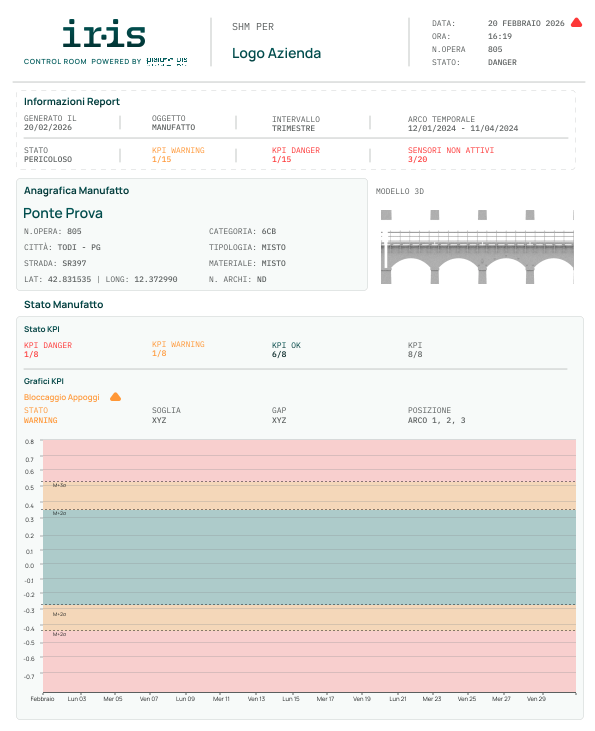
DangerWarningOKAutomatic, modular, and customisable reports
The platform allows to receive automatic reports or generate them on demand, selecting features and level of detail according to the needs of each stakeholder. Reports range from high-level overviews for efficient record-keeping to complete time series, useful for in-depth analysis and supporting inspections and maintenance actions.
Want to try Iris independently?
Receive your access credentials and
explore all available features
in demo mode.
FAQ
Displaid in details
01-What is a management platform for bridge networks and infrastructure?
A management platform for bridge networks and infrastructure is a digital system that collects, organises, and presents all relevant information about an asset portfolio in a structured way. It integrates monitoring data, geometric information, inspection history, and documentation, giving the manager a unified and up-to-date view of asset condition.
02-Why is infrastructure digitalisation crucial for network managers?
Digitalisation is essential because it overcomes fragmented, reactive management based on inconsistent data and episodic decisions. Digital tools allow managers to monitor structural evolution over time, track interventions and critical issues, improve planning, and reduce operational risks, costs, and uncertainties.
03-What is the relationship between structural monitoring (SHM) and digital platforms?
Structural Health Monitoring (SHM) continuously provides data on the actual behaviour of assets, while digital platforms contextualise, interpret, and make these data actionable. Without a platform, monitoring data remain isolated; without SHM, the platform loses connection to the structure’s real response.
04-Why integrate sensors, data analysis, and software into a single platform?
Integrating sensors, data analysis, and software into one platform creates a coherent and updated picture of infrastructure condition. This integration enables the transition from raw data to a digital twin: a dynamic representation combining monitoring, models, and historical information to support technical and strategic decision-making more effectively. In some cases, the digital twin can also incorporate advanced geometric data, such as 3D models or point clouds, merging survey and monitoring data for a complete view.