Automated Operational Modal Analysis of a steel truss railway bridge employing free decay response
Autori:
Abstract:
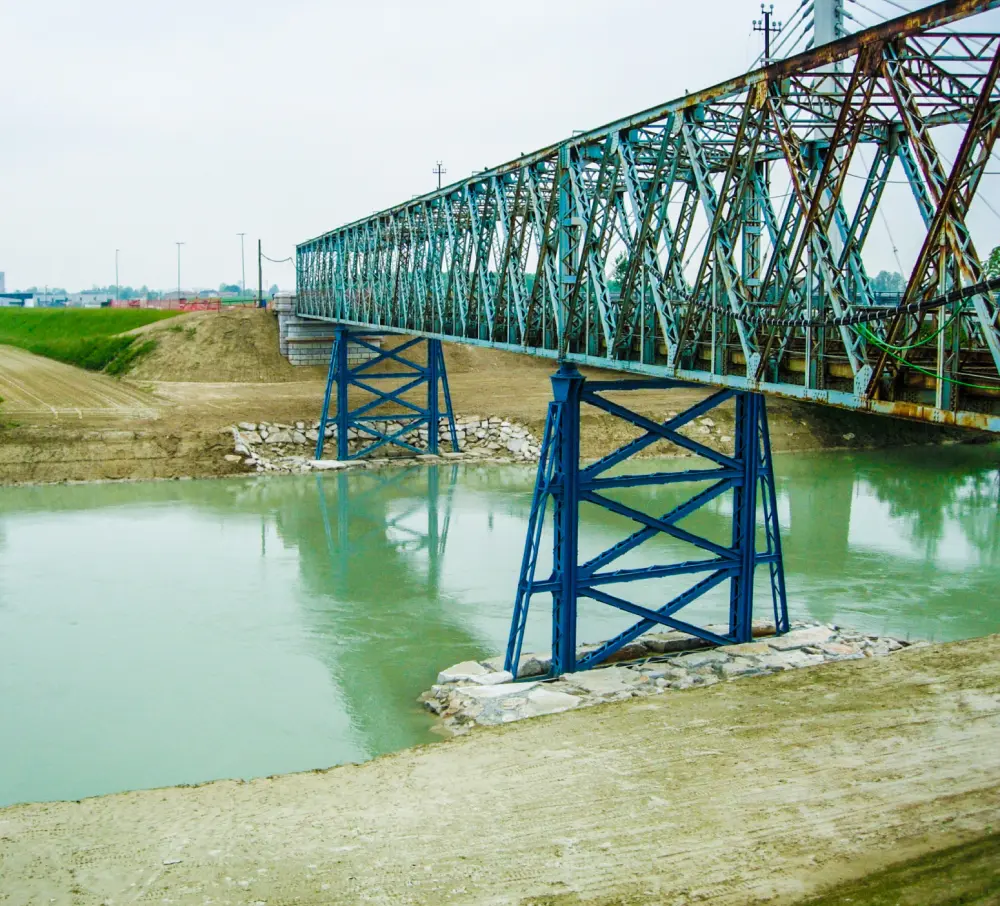
The efficiency and resilience of transportation networks depend significantly on the integrity of bridges, which are increasingly threatened by ageing, traffic, and extreme climate events. Traditional visual inspections have notable limitations, necessitating the adoption of more objective methods like Structural Health Monitoring (SHM). This study explores the application of Operational Modal Analysis (OMA) to estimate the modal parameters of railway bridges, specifically using the Covariance-based Stochastic Subspace Identification (SSICOV) algorithm. The case study involves a steel Warren truss bridge monitored over 20 months. The research demonstrates that SSI-COV, typically requiring stationary random input, can effectively utilise the bridge’s free decay responses following train passages. This approach strongly improves signal-to-noise ratio, which is vice-versa critical for railway bridges ambient vibrations due to the very low input energy, enabling precise modal parameter estimation with shorter time windows and lower-performance sensors. Results were validated against the Peak-Picking (PP) and the Enhanced Frequency Domain Decomposition (EFDD) methods, with SSICOV identifying three additional natural frequencies and exhibiting lower dispersion in frequency estimates throughout the monitored period. Statistical analysis further indicated that using multiple free decays enhances the accuracy and reduces variability for challenging modes, while dominant modes are reliably estimated with minimal decay data. These findings endorse the combination of SSI-COV and free decays as a robust tool for detailed and long-term bridge monitoring, offering a valuable and potentially low-cost alternative to ambient vibration-based OMA techniques.
Paper correlati
Design and Application of a Statistical Learning Methodology to Remove Temperature Effect on Static Signals for Bridge Structural Health Monitoring
Infrastructures are essential for the development and flourishing of countries; in this context, bridges play an irreplaceable role as links for goods and people...

A new methodology to detect corrosion on steel truss railway bridges exploiting local strain gauges: Analytical, numerical, and experimental validation
Steel truss bridges suffer from ageing deterioration phenomena, among which corrosion is the most critical...

Bridge structural monitoring: the Lombardia regional guidelines
In 2018 a collaborative project between Politecnico di Milano (PoliMI) and Regione Lombardia (RL) was launched to join forces...
Multidisciplinary investigations of a steel-concrete composite bridge
The paper presents the results from the multidisciplinary investigations performed on Baghetto Bridge. The structure, built in 1966, crosses the Adda...